Introducing Thesisroom: 4 Modules for Thesis Defense Preparation
Most candidates prepare for their thesis defense by practicing with people who have not read their work. Thesisroom reads the thesis and builds the preparation around what is actually in it.

The problem with how candidates prepare for their defense
A doctoral candidate spends three to five years writing a thesis. The document runs sixty to a hundred thousand words. It contains hundreds of citations, a methodology chosen from dozens of alternatives, and a contribution claim that hinges on decisions made on specific pages. When the defense date arrives, this candidate typically prepares by asking a friend to read the abstract and fire questions at them over coffee.
The mismatch is severe. Thesis defense preparation, in its current form, does not account for this reality. Mullins and Kiley (2002) found that examiners form preliminary judgments about a thesis within the first hour of reading, focusing on the clarity of the research question, the coherence between methodology and findings, and whether the contribution claim is justified by the evidence. The questions examiners ask during the viva are grounded in that reading. They reference specific chapters. They probe specific decisions. They test whether the candidate understands not just what they wrote, but why they wrote it that way and not another.
No amount of rehearsing generic questions with a friend replicates this. The friend has not read the thesis. The friend cannot ask about page 134. Thesis defense preparation, for most candidates, amounts to hoping the examiner does not find the weak spots before the candidate does.
What thesis defense preparation actually requires
Effective thesis defense preparation requires three things that are difficult to get from any single source.
The first is specificity. A question like "how would you defend your methodology?" is not useful preparation. A question like "your sample of 38 participants supports descriptive claims, but on page 134 you generalise to all early-career researchers, how would you defend that?" is useful. The difference is that the second question references the candidate's actual work. It names a page. It names a claim. It forces the candidate to think about that specific decision rather than rehearse a generic answer about methodology in the abstract.
The second requirement is citation integrity. One in 277 PubMed-indexed papers now contains fabricated citations, according to a Retraction Watch analysis from 2026. The rise of AI-assisted writing has made the problem worse. A candidate who used any AI tool during drafting may have citations in their bibliography that do not exist, cite papers that do not say what the candidate claims, or reference journals that are predatory. An examiner who checks even one citation and finds it broken will question every other citation in the thesis. That single failure cascades.
The third requirement is structural coherence. A thesis is not a collection of chapters. It is an argument that must hold across chapters. The research question in chapter one must be answered by the findings in chapter four. The theoretical framework in chapter two must actually inform the analysis in chapter three. The limitations section must acknowledge what the methodology cannot deliver. When these connections break, examiners notice. Supervisors notice too, but supervisors are busy. They read chapters in isolation, weeks apart. The structural weaknesses that span chapters often go unflagged until the defense itself.
What Thesisroom does
Thesisroom is a thesis defense preparation tool. It reads the candidate's thesis and runs four modules against it. Each module addresses one of the gaps described above. Every output is anchored to a specific location in the candidate's own work, so the candidate can verify every flag, question, and comment by clicking through to the source passage.
The product serves Master's, doctoral, and postdoctoral candidates who defend their work orally. It does not serve coursework students. It does not write thesis text. It does not generate citations. It does not rewrite passages to bypass plagiarism detection. The integrity policy makes these boundaries explicit.
Module one: Mock Viva Coach
The mock viva module reads the candidate's full thesis and generates thirty to fifty examiner-grade questions, ranked by difficulty. Each question references a specific passage, page, and claim. The candidate sees the question, writes or records an answer, and receives a scored follow-up on three rubrics: clarity, depth, and accuracy.
The questions are not drawn from a generic bank. They are generated from the thesis itself. A question about methodology will name the specific method the candidate chose, cite the page where the choice is justified, and ask the candidate to defend that choice against a named alternative. A question about contribution will quote the candidate's own contribution claim and press on whether the evidence actually supports it.
At the end of a session, the module produces a report naming the candidate's three weakest areas with specific recommendations for what to revisit before the defense.
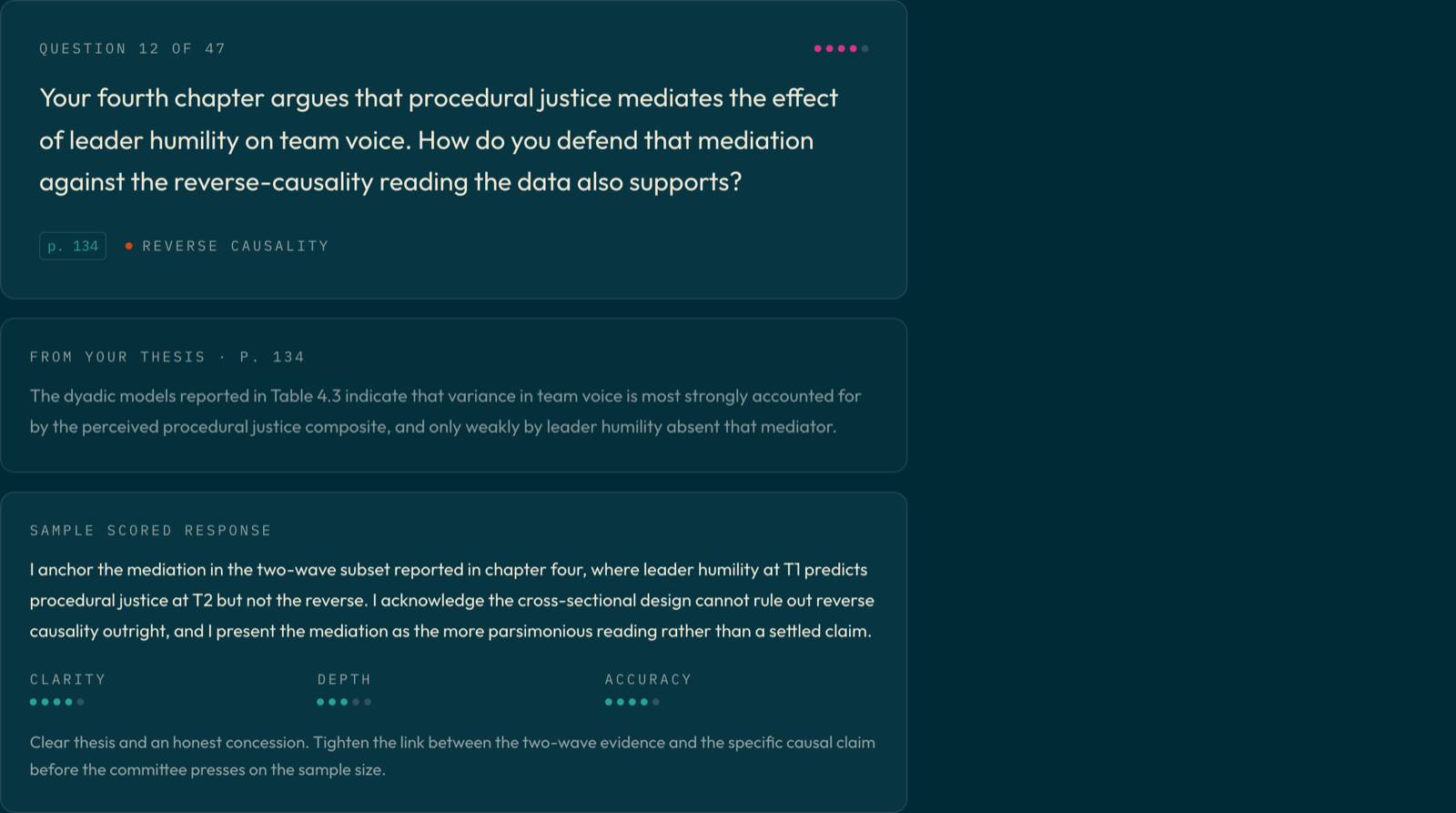
The Mock Viva Coach generates a question from your thesis, shows the exact passage it came from, and scores your answer on clarity, depth, and accuracy.
Module two: Citation Guard
The citation guard extracts every entry in the candidate's bibliography and verifies each one against five academic registries: Crossref, OpenAlex, Semantic Scholar, Retraction Watch, and DOAJ. The verification is mostly deterministic. Crossref confirms whether a DOI resolves. OpenAlex confirms whether the paper exists in the academic record. Retraction Watch confirms whether the paper has been retracted. DOAJ flags predatory open-access venues. The AI is used only for the final step: judging whether a specific paper's abstract actually supports the claim the candidate makes in the text where it is cited.
The result is a traffic-light list. Green means verified. Orange means flagged, with a specific reason (DOI mismatch, author-name discrepancy, year error, claim not supported by abstract). Magenta means unverifiable, meaning the citation could not be found in any source.
Each flag includes the raw response from the registry that produced it. The candidate clicks a flagged citation and sees exactly what Crossref or Semantic Scholar returned. Nothing is hidden behind a black box.
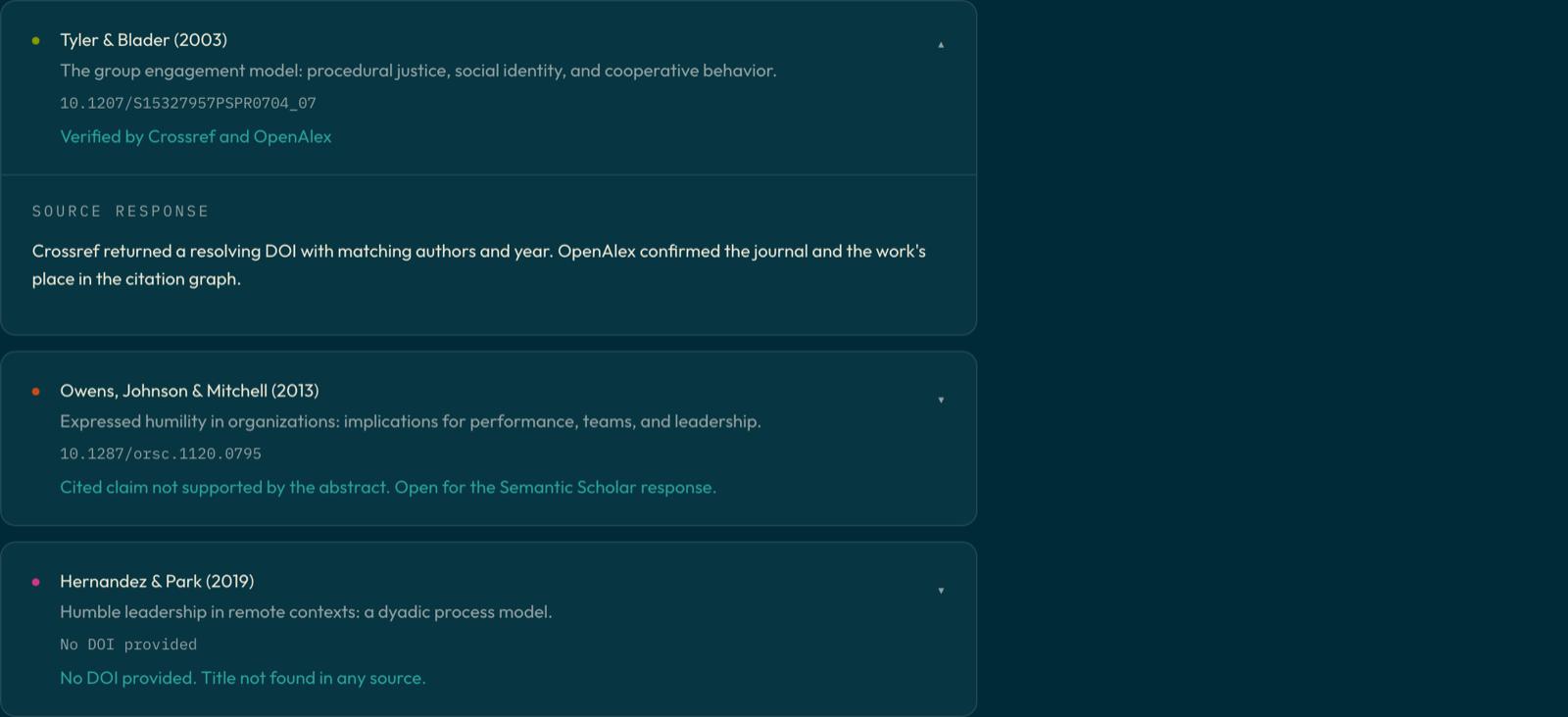
Citation Guard returns a traffic-light list, with the exact registry response behind every flag — nothing hidden behind a black box.
Module three: Structural Critic
The structural critic reads each chapter of the thesis against the standards of the candidate's field and returns margin comments anchored to specific sentences. Each comment is classified by severity: must address, revise, or consider. Each comment includes a one-sentence diagnosis (what is wrong), a revision direction (what to fix), and a link to the heuristic or rule that produced the comment.
Roughly forty percent of the feedback comes from rule-based detection rather than AI reasoning. Missing sections, undefined terminology, citations introduced in late chapters that were absent from the literature review, methodology chapters below a discipline-appropriate word count: these are caught by deterministic checks. The remaining sixty percent requires actual reading comprehension: overclaiming relative to sample size, theoretical frameworks that do not connect to the analysis, arguments that shift between chapters without acknowledgement.
The output reads like Google Docs comments, not like a chatbot response. The candidate sees their chapter text in the centre and the comments in the margin, each connected to a specific sentence by a dotted line.
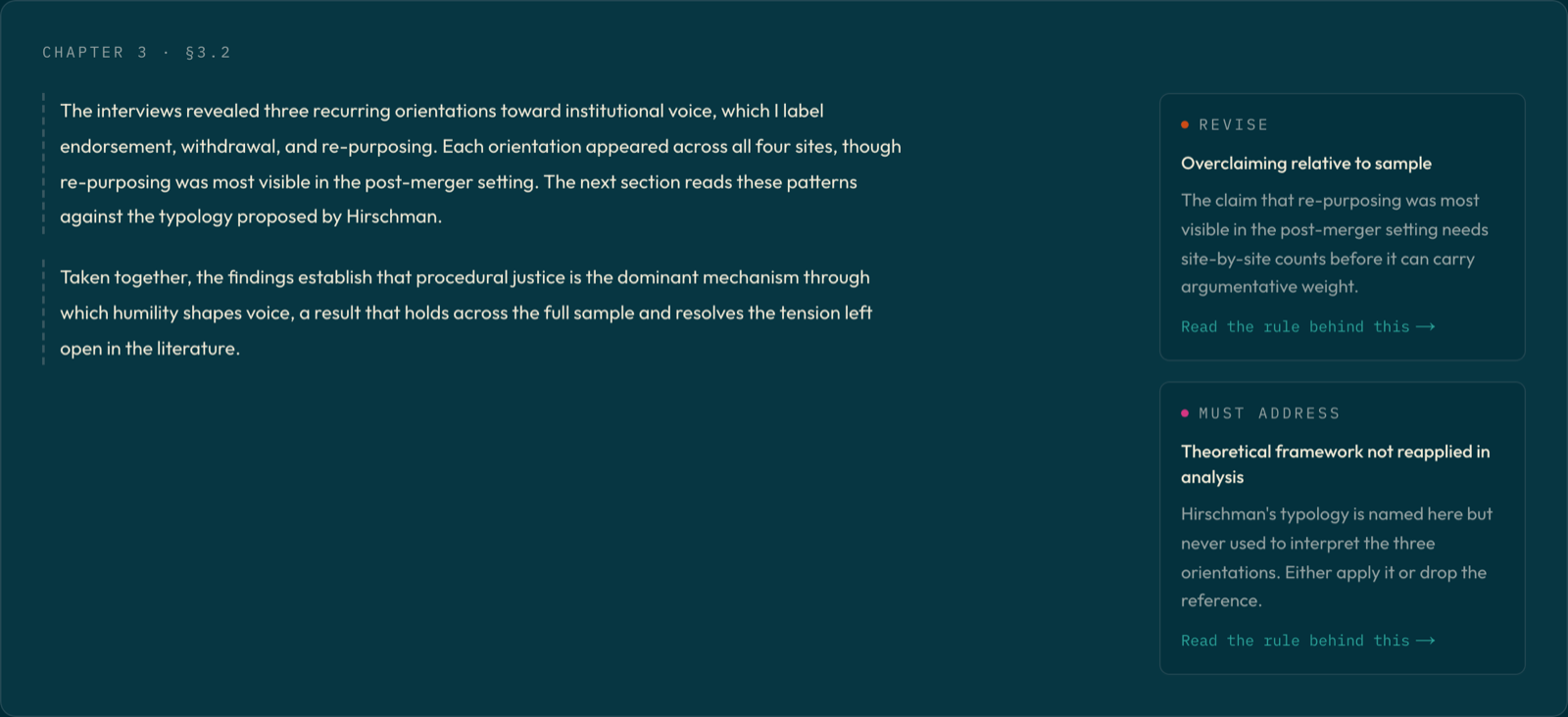
The Structural Critic anchors each comment to a sentence and classifies it as must address, revise, or consider — with the rule behind every comment.
Module four: Source Finder
When the citation guard flags a broken or unverifiable citation, the candidate needs a replacement. The source finder helps them search for verified alternatives without leaving the product. The candidate pastes the sentence from their thesis where they need a citation. The module extracts the claim, queries OpenAlex and Semantic Scholar, and returns a list of real papers that have been verified against the same registries the citation guard uses.
The source finder does not recommend which paper to use. It returns the search results ranked by the database's native relevance score. The candidate reads the abstracts and makes the choice. Every result in the list is verified against Retraction Watch and DOAJ before it is shown, so the candidate never sees retracted papers or predatory-venue publications in the results.

Source Finder returns real, pre-verified papers for the claim you paste — ranked by the database's own relevance, never generated references.
Why the verification layer matters for thesis defense preparation
Most AI tools that interact with academic text have one failure mode that undermines trust: the AI can produce outputs that sound correct but cannot be verified. A generated viva question that references "your methodology" without naming a page is unfalsifiable. A citation flag that says "this looks suspicious" without naming the specific registry response is unverifiable. A structural comment that says "consider strengthening this section" without naming what is weak is useless.
Thesisroom's architecture is built around a different principle. Every output passes through a verification layer before it reaches the candidate. A viva question that does not reference a real passage in the thesis is rejected and regenerated. A citation flag that does not include the specific registry response is not surfaced. A structural comment without a concrete revision direction is filtered out.
The candidate sees only outputs that can be checked. The method page describes this architecture in detail: deterministic checks where possible, AI reasoning where necessary, and an integrity audit layer between the two.
Who Thesisroom is built for
The product serves three audiences, all defined by the same criterion: they defend a thesis orally.
Master's candidates on research-intensive tracks (MSc, MA, MRes, MPhil) who sit a viva or oral examination. Their theses are shorter, typically fifteen to forty thousand words, but the examination standard is no less consequential. The modules calibrate their output to the Master's level.
Doctoral candidates (PhD, EdD, DBA, DMA) in the final weeks or months before their defense. This is the audience the product was designed around. The mock viva module, in particular, targets the specific pressure of a two-to-three-hour oral examination where the examiner has read every page.
Postdoctoral researchers preparing for grant panels, defense repeats required by certain national systems, or other high-stakes oral examinations. Their manuscripts are often longer and more complex than a doctoral thesis. The modules handle the additional scale.
Coursework students, undergraduate essay writers, and anyone not defending a thesis orally are outside the scope. The product communicates this on the first screen of onboarding.
What Thesisroom will not do
Three boundaries are encoded in the product's architecture, not just promised in its marketing.
Thesisroom will not rewrite text to evade plagiarism or AI detectors. The structural critic flags passages that read as AI-generated, but it does so by asking the candidate to revise, not by offering a rewritten version.
Thesisroom will not fabricate citations. There is no code path that allows the AI to suggest a citation the candidate did not include in their bibliography. The source finder returns real papers from real registries. It does not generate plausible-sounding references.
Thesisroom will not ghostwrite. The audit returns margin comments and questions. The writing stays the candidate's. The thinking stays the candidate's. These three boundaries define what thesis defense preparation means inside this product.
Frequently asked questions
How does Thesisroom generate viva questions from my thesis?
Thesisroom parses your full thesis and identifies the claims, methodology choices, and theoretical commitments that carry the most weight in your field. It then generates examiner-grade questions anchored to specific pages and passages. Each question includes a reference to the exact location in your thesis that prompted it, so you can verify the relevance yourself.
Is Thesisroom safe to use before my thesis defense?
Thesisroom is a defense preparation tool, not a writing tool. It does not produce text for your thesis. It does not rewrite your work. It generates questions, verifies citations, and audits structure. Universities that permit candidates to use reference managers, grammar checkers, and library databases would place Thesisroom in the same category. If you are uncertain, share the integrity policy page with your supervisor.
What academic databases does Citation Guard check against?
Citation Guard verifies every bibliography entry against five registries: Crossref for DOI resolution, OpenAlex for existence and author verification, Semantic Scholar for abstract retrieval and claim-support checking, Retraction Watch for retraction status, and DOAJ for predatory open-access venue detection. Most of this verification is deterministic. The AI is used only for the final claim-support judgment.
Can I use Thesisroom for a Master's thesis, not just a PhD?
Yes. Thesisroom serves Master's candidates on research tracks (MSc, MA, MRes, MPhil) who defend their work orally. The modules calibrate their output to your academic level. The onboarding flow asks your level and field, and the question rubrics, structural audit standards, and citation expectations adjust accordingly.
Does Thesisroom store or use my thesis to train its AI?
Thesisroom's AI provider does not use API customer data for model training. Before any thesis text is sent for processing, the system strips your name, your supervisor's name, your institution, and your student ID. The AI processes your academic arguments, not your identity. You can delete your account and all associated data at any time from your settings page.
How much does Thesisroom cost?
The free tier gives you a demo of all four modules: three sample viva questions, fifteen citation verifications, and the first chapter's structural audit. The Defense Sprint plan costs $49 for three months of full access, built for the weeks before your viva. A monthly plan at $19 is available for candidates earlier in their drafting. Full pricing details are on the pricing page.
What happens when I re-upload a revised thesis?
Thesisroom creates a new version of your thesis while preserving all previous runs. You can compare two versions side by side and see which citations were resolved, which structural comments were addressed, and how your viva scores changed. The improvement summary shows the delta between versions so you can confirm your revisions had the intended effect.
One place for the work before the defense
The weeks before a thesis defense are the highest-pressure period of a candidate's academic career. The work is written. The submission is done. What remains is thesis defense preparation for the single oral examination that determines whether the degree is awarded.
Thesisroom exists for that period. Four modules, one thesis, every output anchored to a source the candidate can verify. The product reads the candidate's actual work, not a generic template. It checks citations against the academic record, not against its own memory. It generates questions that reference specific pages, not questions that could apply to any thesis in any field.
The Defense Sprint at $49 for three months covers the window that matters. For candidates earlier in their drafting, the monthly plan at $19 provides the same access on a rolling basis. Both plans include all four modules, unlimited sessions, and the ability to share verification reports with a supervisor.
Start at thesisroom.com.
References
Mullins, G., & Kiley, M. (2002). "It's a PhD, not a Nobel Prize": How experienced examiners assess research theses. Studies in Higher Education, 27(4), 369-386.
Trafford, V., & Leshem, S. (2008). Stepping stones to achieving your doctorate: By focusing on your viva from the start. Open University Press.